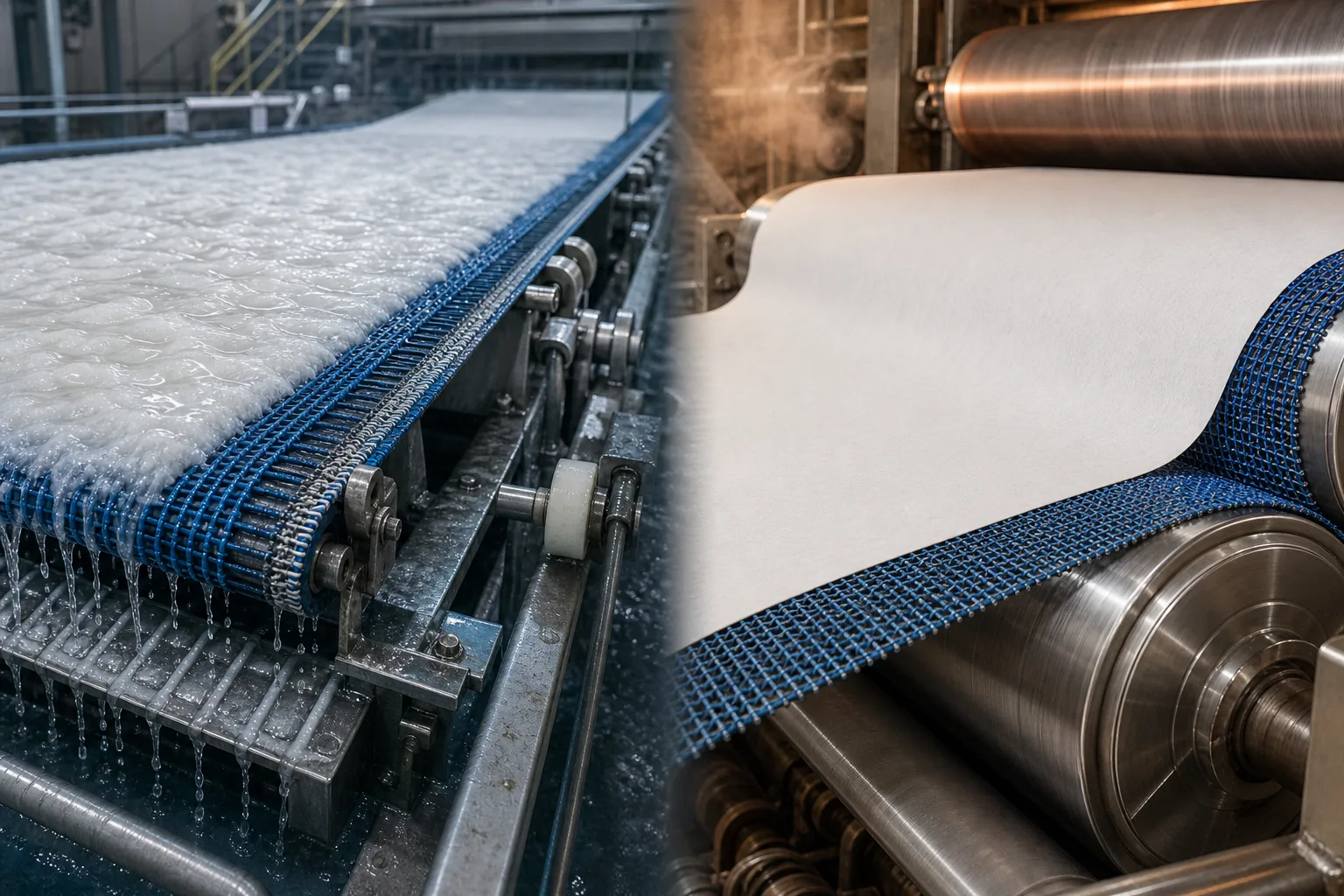
A forming fabric and a dryer fabric are both endless engineered textiles, and both travel around rolls at paper-machine speed. That superficial similarity causes avoidable purchasing mistakes. Their jobs, structures, operating environments, and failure mechanisms are different.
The practical rule is simple: a forming fabric builds the sheet; a dryer fabric carries and controls the sheet while heat removes the remaining moisture. A good specification starts with that distinction, then works back from the machine position and the mill's actual operating data.
Quick Comparison
| Item | Forming Fabric | Dryer Fabric |
| --- | --- | --- |
| Machine section | Forming or wet end | Dryer section |
| Main job | Drain water while supporting and distributing fibers | Hold and guide the sheet over heated cylinders while moisture escapes |
| Sheet condition | Very wet and weak | Consolidated, warmer, and progressively drier |
| Design priority | Fiber support, drainage, formation, stability | Runnability, ventilation, heat resistance, strength, cleanability |
| Typical construction | Single-, double-, 2.5-layer, or SSB multi-layer weave | Flat woven, double-warp, or spiral construction |
| Main contaminants | Fines, fillers, pitch, stickies, chemical deposits | Pitch, stickies, coating ingredients, fiber dust, hydrolysis products |
| Common end-of-life signs | Wear, drainage change, edge damage, sheet marking | Seam wear, contamination, edge curling, loss of permeability, unstable tracking |
These are not interchangeable product labels. They are different categories within paper machine clothing.
The headbox delivers a dilute stock suspension onto the forming fabric. Water must leave through the fabric quickly enough to establish the sheet, but not so aggressively that fibers and fillers are lost or the formation becomes uneven.
The fabric therefore has to balance several duties at the same time:
- support fibers on the paper side;
- provide controlled drainage through the thickness;
- remain stable across the machine width;
- resist abrasion from foils, blades, and vacuum elements;
- release the wet web cleanly at transfer;
- avoid introducing an objectionable wire mark.
This explains why layer construction matters. A modern SSB design can use a fine paper-side surface for fiber support and a more robust machine-side structure for stability and wear life. A coarser, simpler design may still be appropriate for a slower machine or a less demanding packaging grade. There is no universally “best” layer count.
For product details, see our forming fabric range.
What a Dryer Fabric Actually Does
By the time the web enters the dryer section, most free water has already been removed. The remaining moisture is evaporated as the sheet contacts steam-heated cylinders. The dryer fabric supports the web through this long, hot path and helps maintain consistent contact and runnability.
A dryer fabric must:
- guide the sheet through dryer groups;
- help maintain sheet contact with cylinder surfaces;
- allow moisture-laden air to move away;
- remain dimensionally stable under heat and tension;
- pass rolls, stabilizers, doctors, and seals without excessive wear;
- retain adequate seam strength over a long operating period;
- stay clean enough to preserve the required permeability.
This is why dryer-fabric selection cannot be reduced to “open weave equals better drying.” More open area may improve ventilation in one position but reduce sheet control in another. The right design depends on the dryer group, machine speed, ventilation arrangement, paper grade, contamination load, and available cleaning system.
See the dryer fabric product category for common constructions.
Structural Differences You Can See
Paper-side surface
A forming fabric usually presents a carefully engineered fine surface because it contacts individual fibers while the sheet is being created. A dryer fabric contacts an already formed web, so sheet support and surface smoothness still matter, but its structure is optimized around ventilation, stability, and wear.
Thickness and internal voids
Multi-layer forming fabrics separate paper-side and machine-side duties within one woven structure. Dryer fabrics use open woven paths or spiral constructions to balance air movement, sheet handling, and contamination resistance.
Seam design
Many forming fabrics are supplied endless. Dryer positions often require a seam because of the machine layout and installation route. Seam strength, geometry, marking risk, and ease of joining are therefore central dryer-fabric questions.
Material stress
Forming fabrics face vacuum pulses, water, fillers, and abrasion at dewatering elements. Dryer fabrics face heat, humidity, tension, mechanical seals, roll contact, and possible hydrolysis. Material choice and yarn geometry should reflect the actual position rather than a general temperature rating.
Selection Data: Do Not Send Only Width and Length
Width and loop length describe whether a fabric fits. They do not describe whether it will run well.
- former type and exact position;
- machine speed and design speed;
- paper grade and basis-weight range;
- furnish composition and recycled-fiber percentage;
- retention-aid program and filler loading;
- current fabric layer and mesh data;
- current permeability and caliper, if available;
- vacuum arrangement and drainage complaint;
- wear pattern, life history, and sheet-quality target.
For a dryer-fabric enquiry, provide:
- dryer group and single- or double-felted arrangement;
- machine speed and sheet basis weight;
- operating temperature and hood conditions;
- pocket ventilation and stabilizer configuration;
- current fabric construction and permeability;
- running tension and seam type;
- contamination type and cleaning method;
- current life, failure location, and runnability problem.
Photographs of the used fabric, seam, edges, and recurring deposits are often more useful than a long description.
How Wrong Selection Shows Up on the Machine
Poor sheet formation, unusual two-sidedness, rising vacuum demand, fiber carry-under, edge cracking, or fast machine-side wear can all point toward a mismatch. The fabric is not always the root cause; stock preparation, showers, vacuum settings, and dewatering-element condition must be checked at the same time.
Dryer-section symptoms
Sheet flutter, wrinkles, edge instability, wet streaks, rapid contamination, seam marking, or repeated guiding corrections may indicate an unsuitable fabric or a machine condition outside the design window. Dryer-cylinder surfaces, seals, rolls, pocket ventilation, and cleaning equipment belong in the same investigation.
A Better Way to Compare Supplier Proposals
Do not compare two offers only by fabric weight, quoted permeability, and price. Ask each supplier to explain:
- why the proposed structure fits this exact position;
- what operating problem the design is intended to solve;
- which machine data were used;
- what start-up and cleaning conditions are required;
- how performance will be measured after installation.
A technically sound proposal should be specific enough that the mill can test it against operating results.
Final Takeaway
Forming fabrics and dryer fabrics belong to the same PMC system, but they should be specified through different decision paths. Start with the fabric's function and machine position, document the current problem, and then compare designs against measurable targets.
If you are preparing an enquiry, send HengXing the current fabric specification together with machine speed, paper grade, position, operating conditions, and used-fabric photographs. That gives the application team enough context to recommend a design rather than simply quote a size.


