Paper machine clothing rarely fails without warning. The warning may be subtle: a guide that works harder than usual, a cross-machine discoloration, a gradual moisture change, a polished edge, or a seam that no longer looks uniform.
The purpose of maintenance is not to make every fabric run for the maximum number of days. It is to keep performance predictable and remove the fabric before it creates a quality, safety, or downtime problem.
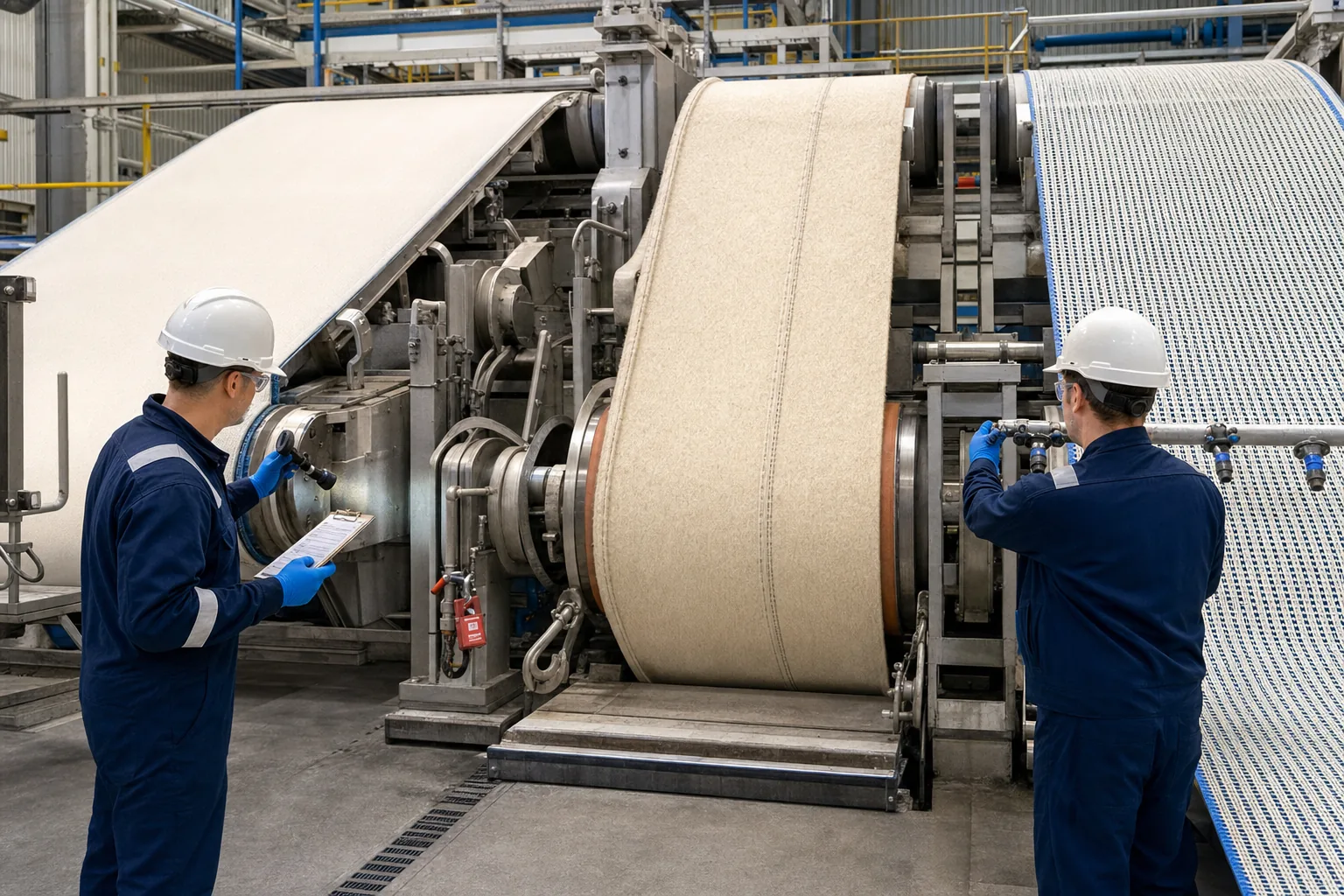
Build One Routine, Then Adapt It by Position
A useful PMC maintenance program has four layers:
- shift observations;
- scheduled measurements;
- cleaning and conditioning;
- planned-shutdown inspection.
The checklist can be shared across the machine, but limits and methods must be specific to the forming fabric, press felt, and dryer fabric.
Every-Shift Observations
Operators do not need a laboratory to catch early problems. A consistent visual and operating check is often enough.
Record:
- fabric tracking and guide activity;
- edge position and any rubbing;
- seam passage and unusual vibration;
- shower pattern and plugged nozzles;
- new streaks, deposits, or color changes;
- sheet release, flutter, wrinkles, or marking;
- abnormal vacuum, drive load, tension, or moisture trend;
- any grade, furnish, chemical, or speed change.
Use the same inspection points each shift. Free-form comments are difficult to compare; a short fixed checklist reveals trends.
Forming Fabric Maintenance
Keep the drainage path open
Fines, fillers, pitch, and stickies can reduce effective drainage even when the fabric still looks acceptable from a distance. Observe vacuum demand, water carry, sheet release, and cross-machine consistency.
Check showers as a system
A shower bar with several partially plugged nozzles can create a repeating cross-machine pattern. Check nozzle alignment, pressure, oscillation, filtration, and distance. Do not correct a poor spray pattern simply by raising pressure.
Watch machine-side wear
Inspect contact with forming boards, foils, blades, and vacuum-box covers. Wear lines often identify a damaged, misaligned, or contaminated stationary element. Replacing the fabric without correcting that contact point repeats the failure.
Protect the edges
Edge showers, deckles, guiding, and frame clearances all affect edge life. Look for fraying, curling, polished yarns, and repeated contact marks.
For installation controls, use the PMC installation checklist.
Press Felt Maintenance
Press felts require conditioning as well as cleaning. Their void structure must accept water at the nip and release it through the dewatering system.
Monitor sheet dryness after press, uhle-box vacuum, water removal, shower operation, felt moisture, and drive load. A single reading is less useful than a trend under similar grade and speed conditions.
Distinguish filling from compaction
A felt can lose performance because pores are filled with contaminants, because the structure has compacted, or because both have occurred. The correction is not always more chemical. Used-felt inspection and cross-machine measurements help separate the causes.
Protect the batt surface
Incorrect nozzle distance, damaged shower tips, roll defects, and aggressive manual cleaning can disturb or cut batt fibers. Follow the felt supplier's cleaning limits and inspect the surface under good lighting.
Read Press Felt Conditioning Optimization for a position-specific routine.
Dryer Fabric Maintenance
Preserve useful permeability
Dryer fabrics often have a long service interval, so gradual filling can be overlooked. Compare permeability and cleanliness over time rather than waiting for a sudden drying complaint.
Inspect seams and edges
The seam passes every roll and cylinder once per revolution. Check loop damage, uneven joining, deposits, thickness change, and marking. At the edges, look for rubbing, curl, broken yarns, and heat-polished areas.
Check nearby machine elements
Seals, stabilizers, doctors, rolls, and guide equipment can create abrasion or local heating. Confirm clearances during a planned shutdown. A fabric cannot compensate for continuous mechanical contact.
Match cleaning to contamination
Identify whether the deposit is pitch, stickies, coating material, oil, dust, or chemical scale. Choose water, chemistry, temperature, and dwell time accordingly. Verify chemical compatibility before use.
Cleaning: More Pressure Is Not a Maintenance Strategy
Cleaning performance depends on:
- nozzle condition and spray shape;
- pressure and flow;
- distance and impact angle;
- oscillation speed;
- suction or contaminant removal;
- chemical compatibility;
- whether the machine is running or locked out.
High pressure used incorrectly can damage monofilaments, press-felt batt, seams, and edges. It can also push contamination into the structure instead of removing it.
Never carry out manual inspection or cleaning near moving clothing unless the mill's approved guarding, isolation, and safety procedure specifically permits the task. Planned shutdown work should follow lockout and site safety requirements.
Choose a small set of data that operators can collect consistently.
| Section | Useful trend data |
| --- | --- |
| Forming | Vacuum, drainage behavior, retention, drive load, wear observations |
| Press | Sheet dryness, felt moisture, uhle vacuum, water removal, nip-related marks |
| Dryer | Permeability, steam or drying trend, guide activity, deposits, seam and edge condition |
Add production context: paper grade, basis weight, speed, furnish, chemicals, and cleaning events. Without context, two readings may not be comparable.
Planned-Shutdown Checklist
During a shutdown:
- mark running direction and machine side before sample removal;
- inspect rolls for buildup, coating damage, and sharp points;
- inspect stationary covers, foils, seals, doctors, and clearances;
- check shower nozzles, filters, oscillators, and pipes;
- photograph full width, edges, seam, and unusual defects;
- measure remaining thickness or permeability where appropriate;
- review guide sensors and actuators;
- inspect frames and installation routes before fitting a new fabric;
- save a representative used sample for supplier analysis.
The shutdown report should state what was found and what was corrected. “Fabric changed” is not a root-cause record.
When to Call the Supplier
Contact the application team before the issue becomes an emergency when you see:
- a new defect repeating in the machine direction;
- rapid cross-machine performance change;
- unusual seam or edge damage;
- service life falling over several consecutive fabrics;
- a large difference between clean and dirty permeability;
- a grade conversion or speed increase outside the original design basis.
Send photographs with orientation, machine position, fabric age, current specification, operating data, and the date the symptom began.
How to Judge Service Life
Calendar days alone can be misleading. Compare:
- tons produced;
- running hours;
- number of grade changes and wash cycles;
- average speed and tension;
- quality losses or breaks;
- energy and dewatering performance;
- reason for planned removal.
A fabric that runs longer but causes quality loss, extra steam, frequent breaks, or an unsafe seam is not necessarily the lower-cost choice.
Final Takeaway
Good PMC maintenance is a repeatable observation and recording process. Keep showers working, preserve the fabric structure, inspect machine contact points, and connect each defect with operating history. That gives the mill better control of service life and gives the supplier enough evidence to improve the next fabric specification.


