Dryer-fabric enquiries often begin with three numbers: width, length, and permeability. Those numbers are necessary, but they are not enough to select a fabric.
A dryer section contains positions with different sheet-support demands, temperatures, ventilation conditions, contamination loads, and mechanical risks. A fabric that runs well in one group can be a poor choice in the next. Selection should therefore be position by position, with a clear reason for every design choice.
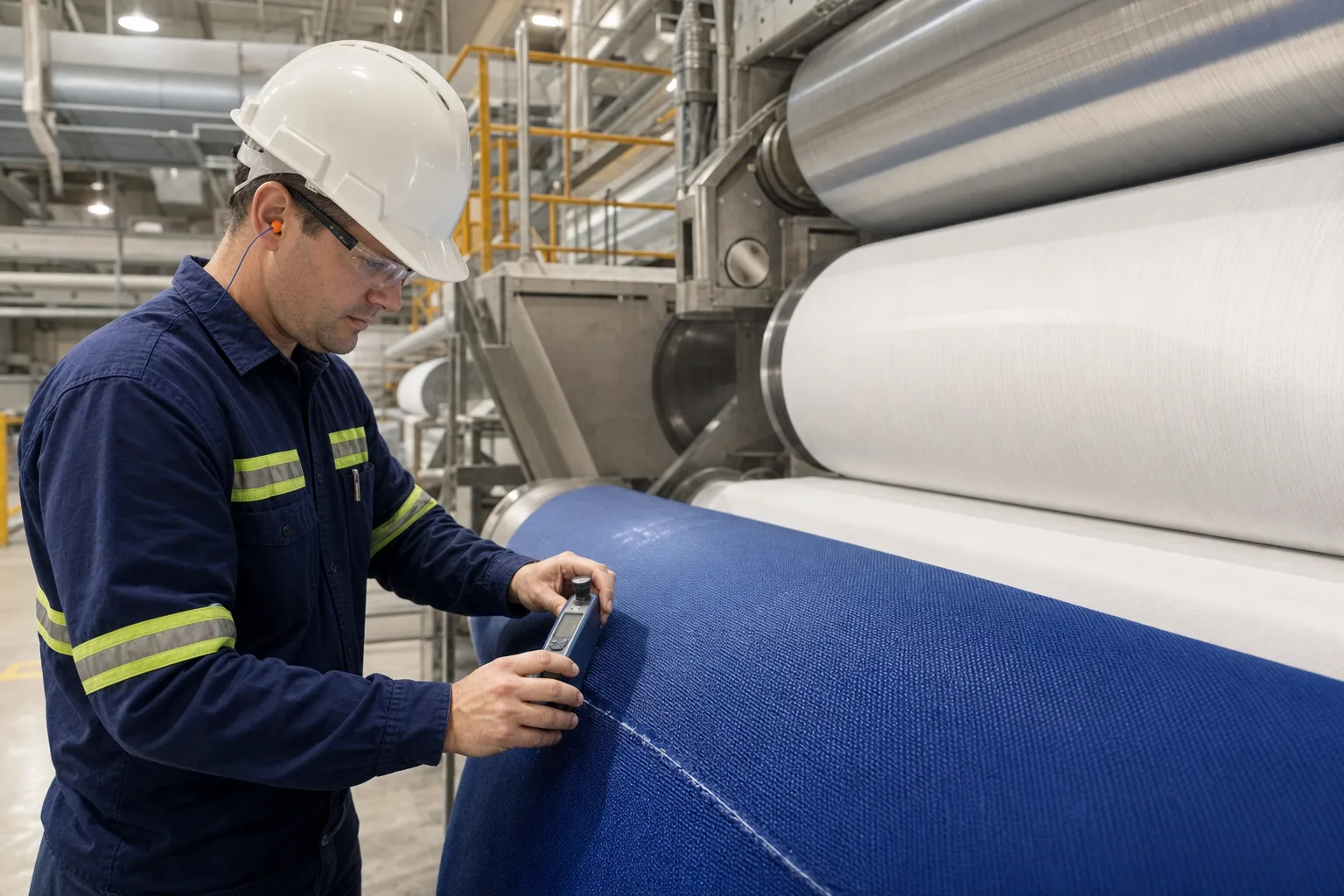
Start with the Job of the Exact Dryer Group
Before discussing weave, first ask what the fabric must do in that position.
Early dryer groups often handle a weaker, wetter sheet and may place more emphasis on support and runnability. Later groups handle a stronger sheet but can expose the fabric to different temperatures, deposits, ventilation conditions, and abrasion risks. Single-felted groups, double-felted groups, top positions, and bottom positions also impose different demands.
Record the exact group and position. “Dryer section” is not a complete location.
1. Paper grade and basis-weight range
Tissue, fine paper, recycled liner, kraft paper, and pulp drying do not ask the same thing from a dryer fabric. Lightweight or mark-sensitive grades may need different support characteristics from heavy packaging grades. Recycled furnish can bring a higher stickies load and change cleaning priorities.
2. Machine speed
Higher speed increases the importance of sheet control, dimensional stability, guiding response, and aerodynamic behavior. Use both normal running speed and planned maximum speed. A fabric selected only for today's speed may become a constraint after a production increase.
3. Dryer configuration
Document whether the group is single- or double-felted, the fabric path, roll diameters, stabilizers, vacuum rolls, pocket ventilation, and any close-running seals. These details influence fabric stability, abrasion risk, and air movement.
4. Temperature and humidity
Dryer-hood conditions combine heat and moisture. This can be more demanding than dry heat alone. Give the supplier operating temperature, hood balance concerns, condensate issues, and any history of brittle or chemically degraded yarns.
5. Permeability
Permeability affects air and moisture movement, but it is a system parameter rather than a stand-alone quality grade. Compare the current fabric's initial value, in-service trend, and end-of-life condition. If drying declines while the fabric becomes visibly filled, the cleaning and contamination picture matters as much as the original specification.
For a deeper explanation, read How Dryer Fabric Air Permeability Affects Efficiency.
6. Contamination
Identify the deposit rather than calling everything “dirt.” Pitch, stickies, coating ingredients, fiber dust, oil, and chemical precipitates respond differently to fabric structure and cleaning. Note where deposits begin and whether they follow a cross-machine pattern.
7. Tension, guiding, and edge behavior
Record normal tension, guide movement, edge curling, rubbing points, and any tendency to run to one side. Uneven tension or a mechanical contact point can destroy a suitable fabric. A new design should not be expected to compensate indefinitely for a machine defect.
8. Seam and installation route
The seam is a functional part of the fabric. The mill should discuss seam strength, thickness, joining method, installation access, marking sensitivity, and the condition of the seam after service. A seam that is easy to install but unsuitable for the position is not a good compromise.
Woven or Spiral?
Both constructions can work well when correctly applied.
| Question | Woven Dryer Fabric | Spiral Dryer Fabric |
| --- | --- | --- |
| Surface and support | Broad range of weave options, including smoother surfaces | Depends on coil and insert design; check marking sensitivity |
| Permeability range | Can be engineered across many dryer positions | Often selected where more open structure is useful |
| Contamination release | Depends on yarn shape and weave | Open coil structure can be easier to clean in suitable applications |
| Seam | Woven seam options vary by design | Pin-style joining is common and can simplify installation |
| Mechanical conditions | Strong woven designs suit demanding tension and abrasion positions | Must be matched carefully to roll, edge, and sheet-control conditions |
Do not choose spiral simply because it looks more open, or woven simply because it looks smoother. Start with the position's limiting problem.
Compare the flat-yarn dryer fabric, round-yarn dryer fabric, and spiral dryer fabric product pages. You can also browse the complete woven polyester dryer fabric category.
How to Read a Used Dryer Fabric
A used fabric is a record of the machine.
Inspect:
- paper-side and roll-side deposits;
- cross-machine streaks;
- wear close to seals and stationary elements;
- seam wear and damaged loops;
- edge fraying, curling, or polished areas;
- localized distortion;
- permeability difference between clean and contaminated zones;
- yarn brittleness or surface cracking.
Mark the running direction and machine side before removing the sample. Without orientation, much of the diagnostic value is lost.
Common Purchasing Errors
Copying the old specification without reviewing the old result
An exact repeat is sensible only when the current fabric meets life, runnability, drying, and quality targets. If it does not, record the failure before placing the next order.
Comparing quoted permeability without test context
Test method, pressure, units, and fabric condition matter. Ask suppliers to state the test standard and do not mix values taken by different methods.
Treating maximum temperature as the complete material decision
Heat, moisture, chemistry, tension, and time interact. A nominal temperature rating alone does not describe hydrolysis resistance or long-term dimensional stability.
Ignoring the cleaning system
Fabric design and cleaning capability must work together. Shower pressure, nozzle condition, oscillation, suction, chemical compatibility, and shutdown washing all affect how long useful permeability is retained.
Accepting a proposal with no measurable target
Define success before installation. Possible measures include service days, stable permeability, fewer guiding corrections, lower steam demand at comparable production, reduced sheet breaks, or cleaner seams and edges.
Dryer Fabric Enquiry Checklist
Send the following with the request:
- machine manufacturer, model, and dryer position;
- fabric width, length, and seam requirement;
- paper grade and basis-weight range;
- normal and maximum speed;
- single- or double-felted arrangement;
- operating temperature and hood conditions;
- current construction and permeability;
- running tension;
- cleaning equipment and chemicals;
- current service life and reason for removal;
- photographs of the used fabric, seam, edges, and deposits.
If several positions use different specifications, prepare one sheet per position. This prevents data from being mixed during quotation.
After Installation: Verify the Recommendation
Record the new fabric's installation date, initial tension, tracking behavior, permeability, seam condition, and production conditions. Check again after the fabric has settled. Later, compare performance under similar grade and speed conditions.
The goal is not simply to achieve a long calendar life. A dryer fabric should provide stable sheet handling, usable permeability, acceptable cleanliness, and predictable removal from service.
For a construction-level comparison, read Flat-Yarn vs Round-Yarn Dryer Fabric. For the wider forming, press and dryer system, review HengXing's paper machine clothing solutions. When requesting a recommendation, send the machine and position data listed in the enquiry checklist above.
Final Takeaway
Dryer-fabric selection is an application decision, not a catalog lookup. The best starting point is a complete position sheet and a clearly documented problem. When the supplier understands the dryer group, paper grade, speed, ventilation, contamination, seam, and service history, the recommendation becomes easier to evaluate—and more likely to produce a measurable result.


