Table of Contents
- What Is Paper Machine Clothing?
- The Four Core Types of PMC
- How PMC Works in the Paper Machine
- Materials Used in Modern PMC
- Key Quality Parameters to Evaluate
- Signs Your PMC Needs Replacement
- How to Choose a PMC Supplier
- Frequently Asked Questions
- Conclusion & Next Steps
What Is Paper Machine Clothing?
Paper machine clothing (PMC) is the collective term for the engineered fabrics that carry the paper sheet through every stage of the papermaking process — from the initial 99% water slurry at the headbox to the final dry sheet at the reel. Without PMC, modern paper production would simply not function.
Think of PMC as the conveyor belt system of a paper machine, but infinitely more sophisticated. These are not simple transport belts. Each fabric type is a precision-engineered textile designed to perform specific functions at specific positions along the machine: draining water, supporting fibers, transferring the delicate wet sheet, squeezing out moisture, and holding the sheet against heated cylinders for final drying.
The term "clothing" comes from the industry's textile heritage — just as clothing protects and shapes the human body, PMC protects and shapes the paper web. The three positions on a paper machine each require fundamentally different fabric designs:
| Section | Fabric Type | Primary Function | Water Content (In → Out) |
|---------|-------------|------------------|---------------------------|
| Forming | Forming Fabric | Drainage + sheet formation | ~99% → ~80% |
| Press | Press Felt | Mechanical dewatering | ~80% → ~50% |
| Dryer | Dryer Fabric | Thermal drying + sheet support | ~50% → ~5% |
Did you know? The global paper machine clothing market is valued at over $2.5 billion annually, driven by the relentless demand for higher machine speeds, better paper quality, and lower energy consumption. The right PMC decisions can reduce a paper mill's operating costs by 10–20%.
The Four Core Types of PMC
The forming fabric operates in the wet end of the paper machine — the most critical section for paper quality. A highly diluted fiber suspension (approximately 1% fiber, 99% water) is jetted onto the fabric through the headbox. As the fabric moves at speeds up to 2,200 meters per minute, water drains through the mesh while fibers are retained on top, forming a continuous wet web.
Key characteristics:
- Fine mesh structure (35–65 threads/cm warp)
- Precise air permeability control (400–800 L/m²·s)
- Available in single-layer, double-layer, 2.5-layer, and SSB triple-layer designs
- Determines sheet formation quality, fiber retention, and initial drainage
Layer types at a glance:
| Layer Type | Best For | Typical Life |
|------------|----------|--------------|
| Single Layer | Low-speed packaging grades, cost-sensitive applications | 30–45 days |
| Double Layer | Medium-speed machines, balanced performance | 45–60 days |
| 2.5 Layer | Bridge solution, good cost-performance ratio | 50–70 days |
| SSB Triple Layer | High-speed tissue and premium grades | 60–90+ days |
→ Deep dive: What Is Forming Fabric? Types, Functions, and Key Parameters
2. Press Felt
After the forming section, the wet paper web — still containing about 80% water — enters the press section. Here, the press felt carries the sheet through a series of rotating press rolls that apply high mechanical pressure (nip pressures up to 1,000+ kN/m) to squeeze water out of the sheet and into the felt.
Press felts are fundamentally different from forming fabrics. They are needle-punched nonwoven textiles — thick, compressible blankets made from polyamide (nylon) and polyester fibers needled into a woven base fabric. Their open, porous structure absorbs water expressed from the sheet during each press nip.
Key characteristics:
- Heavy basis weight: 1,200–1,800 g/m²
- Low air permeability: 30–120 L/m²·s (designed to hold water, not drain air)
- Two main constructions: BOM (Batt-on-Mesh) and BOB (Batt-on-Base)
- Directly impacts sheet dryness entering the dryer section — every 1% dryness gain reduces steam consumption by ~4%
→ Deep dive: What Is Press Felt? Function, Types, and Selection Criteria
3. Polyester Dryer Fabric
The dryer section is the most energy-intensive part of the paper machine, consuming roughly 70% of total energy input. The polyester dryer fabric holds the paper sheet tightly against steam-heated cylinders (typically 120–180°C) as residual moisture is evaporated.
Unlike forming fabrics and press felts, dryer fabrics deal with a mostly-dry sheet. Their job is to maximize heat transfer from the cylinders to the sheet while allowing evaporated moisture to escape.
Key characteristics:
- Made from 100% PET (polyester) monofilament
- Air permeability: 600–1,200 L/m²·s
- Two weave types: flat woven (smooth surface) and double warp (higher strength)
- Operating temperature: up to 180°C continuous
- Width capability: up to 12.5 meters
- Longest service life of all PMC: typically 180–365 days
→ Deep dive: What Is Polyester Dryer Fabric? Complete Guide for Paper Mills
4. Spiral Dryer Fabric
The spiral dryer fabric is an alternative dryer section design that uses interconnected spiral coils instead of woven yarns. Each coil links to the next, creating a chain-mail-like structure that offers the highest air permeability in the dryer fabric category.
Key characteristics:
- Spiral coil construction (2.8–4.5 mm coil diameter)
- Maximum air permeability: 1,000–1,800 L/m²·s
- Available in PET (180°C max) or PPS (200°C max) materials
- On-site repairable — damaged coils can be replaced individually
- Excellent contamination resistance due to self-cleaning coil design
- Ideal for high-temperature sections, pulp drying, and heavy contamination environments
How PMC Works in the Paper Machine
A modern paper machine is a continuous process that transforms a liquid fiber suspension into a solid paper roll in a matter of seconds. Here is how each PMC type functions at its position:
HEADBOX → FORMING SECTION → PRESS SECTION → DRYER SECTION → REEL
   │              │                │                │
   │     Forming Fabric     Press Felt      Dryer Fabric
   │     (drainage +        (mechanical     (thermal
   │      sheet formation)   dewatering)     drying)
   │
   │  ~99% H₂O          ~80% H₂O         ~50% H₂O         ~5% H₂O
Stage 1 — Forming: The headbox sprays a precisely controlled jet of fiber slurry onto the moving forming fabric. Gravity, foil blades, and vacuum boxes pull water through the fabric while retaining fibers on the surface. Within 0.5–1.5 seconds, a continuous wet web is formed.
Stage 2 — Pressing: The wet web transfers (via pickup felt) into the press section where it passes through 2–4 press nips. Each nip consists of two rolls pressing together at high pressure. The press felt absorbs water squeezed from the sheet. After the press section, the sheet has enough strength to support its own weight.
Stage 3 — Drying: The sheet winds through a series of steam-heated cylinders (typically 40–80 cylinders arranged in groups). Dryer fabrics press the sheet against the hot cylinder surfaces, ensuring efficient heat transfer. Evaporated moisture is carried away by ventilation air flowing through the permeable fabric structure.
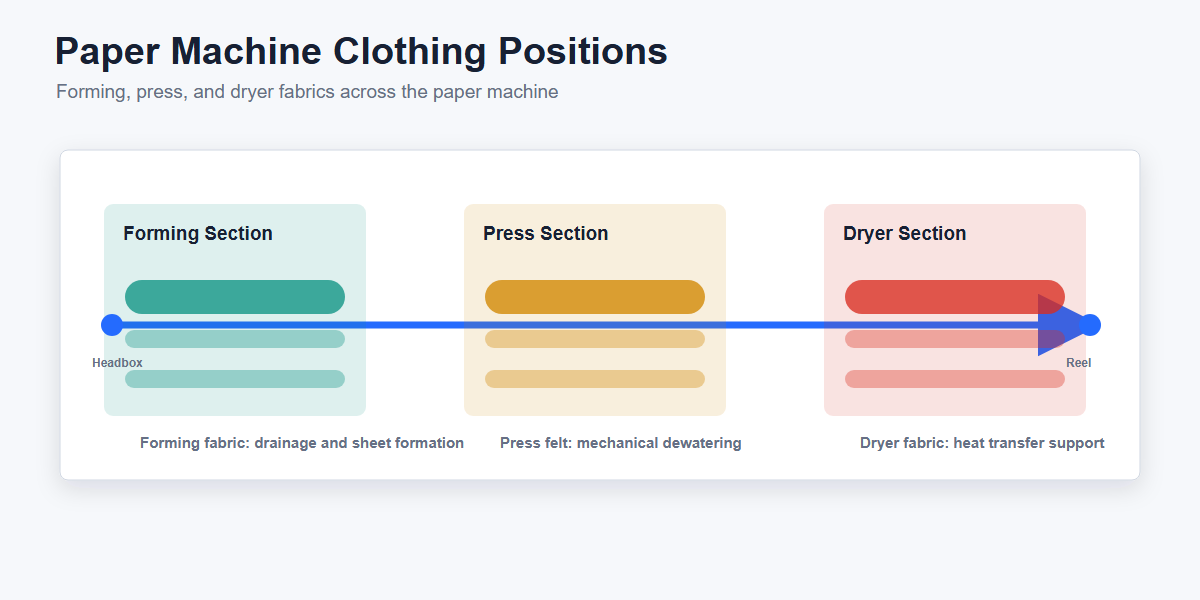 Figure: The three PMC positions on a modern paper machine — forming fabric at the wet end, press felt at the press section, and dryer fabric at the dryer section. Each fabric type is engineered for fundamentally different functions.
Materials Used in Modern PMC
The transition from traditional materials to modern synthetics revolutionized papermaking:
| Era | Forming Fabric | Press Felt | Dryer Fabric |
|-----|---------------|------------|--------------|
| Pre-1960s | Bronze wire mesh | Wool felt | Cotton canvas |
| 1960s–1980s | Polyester monofilament | Synthetic needled felt | Polyester woven |
| 1990s–Present | Multi-layer PET designs | PA/PET engineered blends | High-performance PET/PPS |
Today's dominant materials:
- PET (Polyester): The workhorse of PMC. Excellent dimensional stability, good hydrolysis resistance, cost-effective. Used in forming fabrics, dryer fabrics, and as a blend component in press felts.
- PA (Polyamide/Nylon): Superior elasticity and abrasion resistance. Primarily used in press felt batt fibers. Absorbs water (hygroscopic), which is advantageous in the press section for dewatering.
- PPS (Polyphenylene Sulfide): High-temperature specialist. Rated for continuous operation at 200°C. Used in spiral dryer fabrics for the hottest positions and chemically aggressive environments.
- Hydrolysis-resistant PET: Chemically modified polyester with carboxyl end-group capping for applications where standard PET degrades prematurely due to moisture + heat + chemical exposure.
Key Quality Parameters to Evaluate
When procuring paper machine clothing, these are the technical parameters that directly impact performance:
- Air Permeability (CFM): Measures drainage capacity. Too low = poor drainage, sheet crushing. Too high = excessive fiber loss, poor formation. Optimal range is paper-grade specific.
- Mesh Count (threads/cm): Higher count = better fiber support + smoother sheet surface. Lower count = higher drainage capacity.
- Fiber Support Index (FSI): A calculated metric predicting fiber retention. SSB triple-layer fabrics achieve the highest FSI values.
- Caliper (mm): Fabric thickness. Thicker fabrics last longer but resist drainage more.
For Press Felts
- Basis Weight (g/m²): Heavier felts handle higher nip pressures and provide longer life, but require more conditioning.
- Air Permeability: Press felts need low permeability (30–120 L/m²·s) to efficiently carry water. Excessive permeability indicates compaction or wear.
- Void Volume: The space within the felt structure available for water. Must remain open throughout felt life.
For Dryer Fabrics
- Air Permeability (L/m²·s): The most critical parameter. Must match machine speed and pocket ventilation design. Typically 600–1,200 for woven, 1,000–1,800 for spiral.
- Tensile Strength (N/cm): Must withstand tension required to maintain sheet contact with dryer cylinders.
- Seam Strength: The seam is typically the weakest point. Should exceed 50% of fabric body tensile strength.
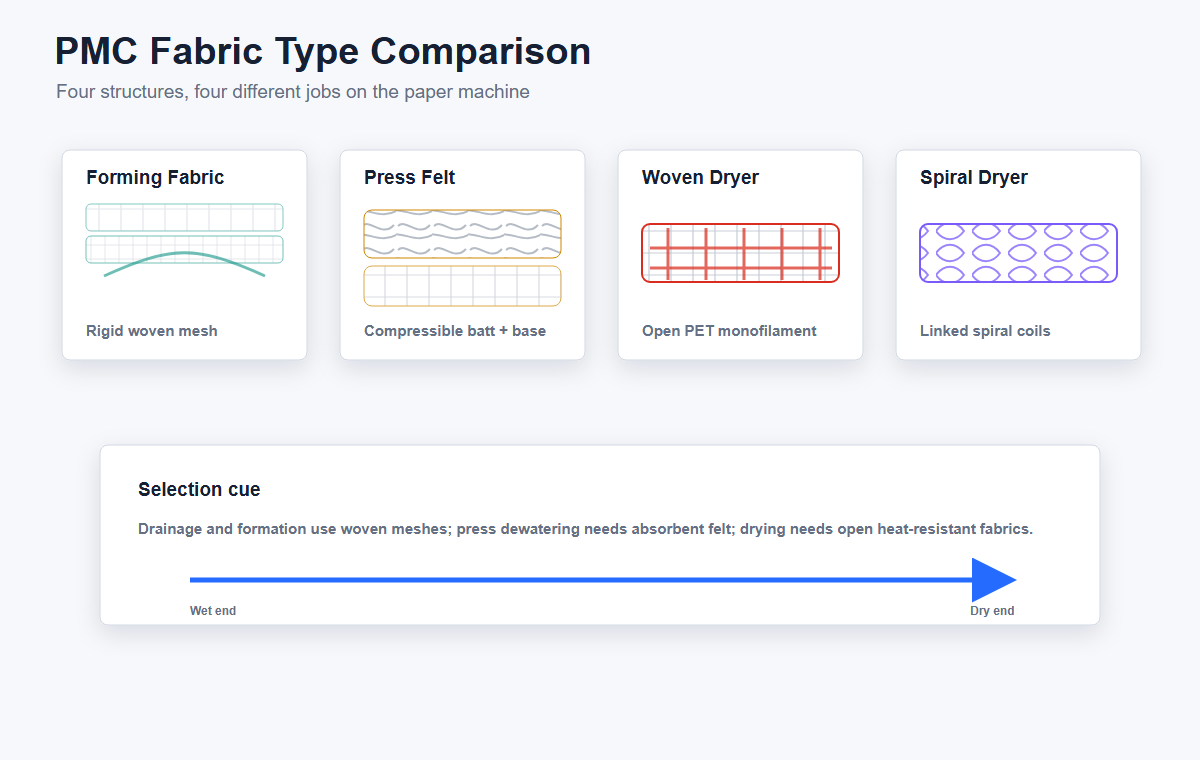 Figure: Cross-section comparison of the four PMC fabric types. Note the fundamentally different structures — forming fabrics are rigid woven meshes, press felts are thick compressible nonwoven composites, and dryer fabrics are open-weave monofilament textiles.
Signs Your PMC Needs Replacement
Recognizing end-of-life signals prevents catastrophic failure and unplanned downtime:
Forming Fabric warning signs:
- Visible wear lines or grooves in the machine direction
- Loss of drainage (higher headbox consistency needed to maintain basis weight)
- Increasing couch vacuum levels
- Edge fraying or seam opening
- Sheet drop-offs or edge cracks
Press Felt warning signs:
- Progressive increase in sheet moisture after the press section
- Visible filling or compaction (felt looks "glazed" or "closed up")
- Increasing vacuum pump load
- Shadow marking on the paper sheet
- Edge wear or delamination
Dryer Fabric warning signs:
- Broken or missing yarns creating holes
- Contamination buildup (stickies, pitch) not responding to cleaning
- Seam wear or failure risk
- Loss of permeability affecting drying rate
- Edge curling or tracking issues
Procurement tip: Establish a predictive replacement schedule based on historical life data rather than waiting for failure. A planned fabric change costs far less than an emergency shutdown.
How to Choose a PMC Supplier
Selecting the right PMC supplier is one of the most consequential procurement decisions a paper mill makes. Here is a systematic framework:
1. Manufacturing Capability
- What looms do they operate? Width capacity? Automation level?
- Do they use European weaving technology (German/Swedish equipment is the industry benchmark)?
- Can they produce all four PMC types, or are they a single-product specialist?
2. Quality Systems
- ISO 9001 certification is table stakes — verify it
- Ask about in-process inspection frequency and methods
- Request sample test reports: air permeability, tensile strength, caliper
3. Technical Support
- Does the supplier provide application engineers who visit your mill?
- Can they analyze used fabrics to identify failure root causes?
- Do they offer fabric audits and performance optimization recommendations?
4. Track Record
- Request references in your specific paper grade (tissue, packaging, kraft, etc.)
- Check how long they have served customers in your region
- Review their export experience and logistics capability
5. Commercial Terms
- Payment terms (T/T, L/C), lead time, minimum order quantity
- After-sales warranty and performance guarantees
- Emergency order capability
HengXing Corp at a glance: ISO 9001 certified since 2010. German and Swedish weaving technology. 120,000 m² factory with 500,000 m² annual output. Products operating in 10+ countries. Dedicated technical support team. 15–25 day standard delivery.
From Our Factory Floor
In 2018, a packaging mill in Indonesia approached us with a persistent problem: their double-layer forming fabric was lasting only 22–26 days on a Fourdrinier machine producing kraft linerboard at 650 m/min. The mill had been purchasing from a local supplier and assumed "all forming fabrics are the same."
Our application engineer flew to the site and spent two days on the machine floor. Within the first shift, he identified three issues: the foil blades had developed sharp edges from years of ceramic insert wear (creating micro-cuts in the fabric's machine-side yarns), the fabric tension was 15% above specification (accelerating edge wear), and the cleaning shower nozzles were partially clogged (allowing fiber buildup between the layers).
Solution: We supplied an SSB triple-layer forming fabric with abrasion-resistant machine-side yarns, provided detailed tension guidelines, and recommended a foil blade replacement schedule. The mill implemented all three changes.
Result: Fabric life increased from 22–26 days to 68 days on the first run. Annual fabric consumption dropped from 14 fabrics per year to 5. The foil blade replacement paid for itself in reduced fabric costs within four months.
Lesson: PMC performance is never just about the fabric. It's about the entire system — equipment condition, operating parameters, and maintenance practices. A good supplier investigates all three.
Frequently Asked Questions
What are the four types of paper machine clothing?
The four core types are: (1) Forming Fabric — used in the wet end to drain water and form the wet paper web; (2) Press Felt — used in the press section to mechanically squeeze water from the sheet; (3) Dryer Fabric — used in the dryer section to hold the sheet against steam-heated cylinders; and (4) Spiral Dryer Fabric — an alternative dryer fabric design using spiral coil construction for high-temperature, high-contamination applications.
How long does paper machine clothing typically last?
Service life varies significantly by fabric type, machine conditions, and paper grade. Typical ranges: Forming Fabrics 30–90 days (single-layer shortest, SSB triple-layer longest), Press Felts 45–90 days, Polyester Dryer Fabrics 180–365 days, and Spiral Dryer Fabrics up to 24 months. Actual life depends on machine speed, operating temperature, chemical environment, filler content, and cleaning practices.
What materials are used in paper machine clothing?
Modern PMC is primarily made from synthetic monofilament yarns: PET (Polyester) is the most common for forming and dryer fabrics due to its excellent dimensional stability, hydrolysis resistance, and cost-effectiveness. PA (Polyamide/Nylon) is blended into press felts for elasticity and abrasion resistance. PPS (Polyphenylene Sulfide) is used in high-temperature spiral dryer fabrics rated to 200°C.
How do I choose the right paper machine clothing supplier?
Evaluate suppliers on: (1) ISO 9001 quality certification, (2) manufacturing technology (loom type and width capability), (3) technical support team expertise, (4) customer references in similar paper grades, (5) delivery lead time and export experience, (6) customization capability for your specific machine parameters, and (7) after-sales service including on-site support.
What is the difference between woven and spiral dryer fabrics?
Woven (flat woven) dryer fabrics use interlocking warp and weft yarns producing a smooth surface ideal for fine paper grades. Spiral dryer fabrics use connected coil elements creating higher air permeability (1,000–1,800 L/m²·s vs 600–1,200 for woven) and better contamination resistance. Spiral designs are preferred for high-temperature sections, pulp drying, and heavy-duty packaging grades. Spiral fabrics can also be repaired on-site by replacing individual damaged coils.
How much does paper machine clothing cost?
PMC pricing is highly customized based on machine width, fabric type, layer construction, material specifications, and order quantity. Rather than focusing on purchase price alone, evaluate Total Cost of Ownership (TCO): a premium SSB triple-layer forming fabric may cost 50% more upfront but deliver 2–3× longer service life and better sheet quality, reducing overall cost per ton of paper produced. Request a tailored quotation from our technical team for your specific machine parameters.
The Future of PMC: 4 Trends Shaping Procurement Decisions
Understanding PMC today means understanding where the technology is heading. Four developments will reshape how mills evaluate and purchase clothing over the next decade.
1. Machine speeds continue to climb
The latest tissue machines now exceed 2,200 m/min, and packaging lines are pushing past 1,500 m/min. At these speeds, traditional single-layer and even double-layer fabrics cannot deliver the drainage capacity and sheet support simultaneously needed. SSB triple-layer and custom multi-axial constructions will become the baseline, not the premium option. Procurement teams should factor this into their supplier evaluation — does your supplier have the loom technology and design capability for the next generation of fabrics?
2. Sustainability mandates are changing material requirements
European and North American mills face increasing pressure to reduce water consumption, energy use, and carbon footprint. PMC plays a direct role: better dewatering in the press section reduces dryer steam demand. Longer fabric life reduces solid waste. Some mills are now specifying hydrolysis-resistant PET with recycled content and requesting environmental product declarations (EPDs) from suppliers. Expect this to accelerate.
3. Predictive replacement is replacing reactive changeouts
More mills are adopting condition monitoring — tracking fabric permeability trends, vacuum levels, and sheet moisture profiles through their DCS — to predict optimal changeout timing. The mills that do this well carry 30% less safety inventory and suffer 60% fewer unplanned shutdowns. When evaluating suppliers, ask: "Can you help us build a predictive replacement model from our operating data?"
4. The PMC supplier is becoming a technical partner, not a vendor
The days of "send us a quote for 10 fabrics" are ending. Leading mills now expect their PMC supplier to provide application engineering, on-site audits, failure analysis, and performance optimization. This is the model we've operated at HengXing for over two decades — and it's becoming the industry standard.
What This Means for Your Next PMC Decision
Don't evaluate suppliers on price per square meter. Evaluate them on total cost per ton of paper produced, technical support capability, and their ability to grow with your machine as speeds increase and requirements evolve.
📋 Download: Free PMC Selection Checklist
Choosing the right forming fabric, press felt, and dryer fabric for your machine involves dozens of interdependent decisions. We've compiled our application engineering team's evaluation framework into a practical checklist.
📋 Download the PMC Selection Checklist — A 7-step interactive checklist covering paper grade definition, machine parameters, fabric selection (forming/press/dryer), supplier evaluation criteria, and RFQ preparation. Print-ready. Includes bonus TCO analysis worksheet.
📧 Need a custom recommendation? Email our technical team with your machine parameters for a tailored fabric specification within 48 hours.
📞 Direct line: +86 135 2311 0033
Continue exploring the PMC Content Hub:


