Table of Contents
- What Is Polyester Dryer Fabric?
- How the Dryer Section Works
- Polyester Dryer Fabric Construction
- Air Permeability: The Most Critical Specification
- Seam Types: Pin, Spiral, and Endless
- Selecting the Right Dryer Fabric by Paper Grade
- Maximizing Dryer Fabric Life
- Installation Best Practices
- Frequently Asked Questions
- Conclusion & Next Steps
What Is Polyester Dryer Fabric?
The polyester dryer fabric is the workhorse of the paper machine dryer section — the largest, longest, and most energy-intensive part of the papermaking process. Its job is conceptually straightforward: hold the paper sheet in intimate contact with steam-heated cylinders (typically at 120–180°C) so that residual moisture can be evaporated efficiently, while simultaneously allowing that moisture-laden air to escape through the fabric's open mesh structure.
In practice, this is a demanding engineering challenge. A dryer fabric on a modern high-speed machine must:
- Withstand continuous operating temperatures of up to 180°C without degradation or dimensional change
- Maintain precise air permeability to balance drying efficiency with sheet stability (too much airflow causes sheet flutter; too little wastes energy)
- Resist hydrolysis — the chemical degradation of polyester when exposed to moisture + heat simultaneously
- Survive 180–365 days of continuous operation through abrasive contact with dryer cylinders and rolls
- Stay clean and permeable despite exposure to stickies, pitch, and fiber dust carried over from earlier sections
Modern polyester dryer fabrics accomplish all of this as precision-woven monofilament textiles typically 20–35 threads per centimeter, manufactured in widths up to 12.5 meters.
Energy fact: The dryer section accounts for approximately 70% of a paper machine's total energy consumption. Optimizing dryer fabric selection can reduce steam consumption by 5–15% — for a typical paper mill, this translates to hundreds of thousands of dollars annually.
How the Dryer Section Works
After the press section, the paper sheet enters the dryer section at approximately 50% moisture content (50% fiber, 50% water). It exits at approximately 5% moisture — the target for most paper grades. Achieving this requires passing the sheet over 40–80 steam-heated cylinders arranged in multiple groups, or "sections."
FROM PRESS SECTION          DRYER SECTION (40–80 cylinders)         TO REEL
        │          ┌────────────────────────────────────┐                │
  Sheet ~50% H₂O  │  Cyl 1 → Cyl 2 → ... → Cyl N       │     Sheet ~5% H₂O
        │          │  [dryer fabric holds sheet          │                │
        ▼          │   against each hot cylinder]        │                ▼
                   └────────────────────────────────────┘
In each cylinder group:
- The dryer fabric presses the sheet against the hot cylinder surface, maximizing conductive heat transfer
- Water evaporates from the sheet into the surrounding air
- The evaporated moisture is carried away by the dryer section's pocket ventilation system — air that flows through the permeable dryer fabric structure
- Between cylinders, the sheet travels unsupported (open draw) or supported by the fabric (single-tier or bel-run configurations)
The dryer fabric's air permeability directly affects how well this ventilation air can reach the sheet and carry moisture away. Too little permeability restricts drying; too much can cause the sheet to flutter and break at high speeds.
Polyester Dryer Fabric Construction
Flat Woven
The most common construction. Single warp yarns (machine direction) are interwoven with weft yarns (cross-machine direction) in a flat weave pattern. The result is a smooth, uniform fabric surface.
Advantages:
- Smooth sheet-side surface — minimal marking, ideal for fine paper and printing grades
- Good all-around balance of permeability, strength, and surface quality
- Easier to clean — open weave structure sheds contaminants more readily
Best for: Printing & writing grades, tissue, fine paper, and standard applications where sheet surface quality matters.
Double Warp
Two warp yarns are paired together and woven as a single unit. This produces a fabric with significantly higher tensile strength and a slightly more textured surface.
Advantages:
- 25–35% higher tensile strength than equivalent flat woven fabric
- Greater durability and abrasion resistance for heavy-duty applications
- Better dimensional stability under high tension
- Longer service life in demanding conditions
Best for: Kraft paper, linerboard, packaging grades, and any application where mechanical demands are high and slight surface texture is acceptable.
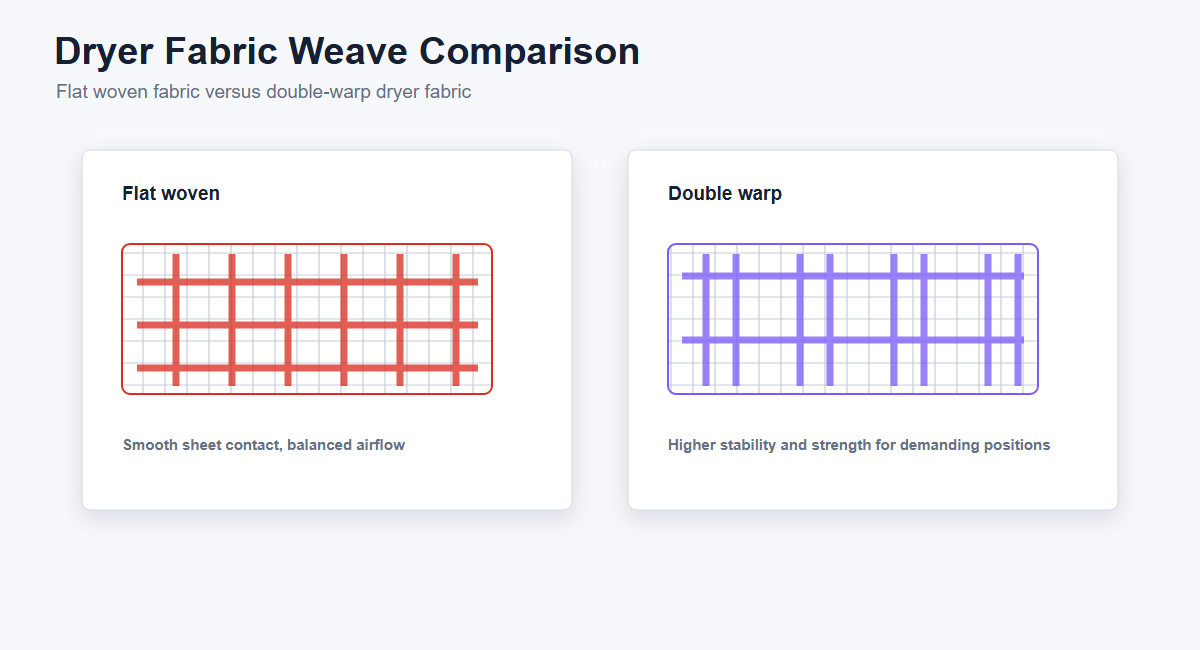 Figure: Flat woven (left) uses single warp yarns for a smooth sheet-side surface. Double warp (right) pairs warp yarns for 25–35% higher tensile strength. Choose flat woven for fine paper grades; double warp for heavy-duty packaging and kraft.
Woven vs Spiral — When to Choose Which
While this article focuses on woven polyester dryer fabrics, it's important to understand when spiral dryer fabrics are the better choice:
| Criterion | Choose Woven (Polyester) | Choose Spiral |
|-----------|--------------------------|---------------|
| Sheet surface quality | ✓ Smooth surface, minimal marking | ✗ Coil pattern may mark sensitive grades |
| Air permeability needed | 600–1,200 L/m²·s | 1,000–1,800 L/m²·s |
| Maximum temperature | 180°C (PET) | 200°C (PPS material option) |
| Contamination level | Moderate | High — self-cleaning coil design |
| On-site repair | Limited | Excellent — individual coils replaceable |
| Installation ease | Standard | Easier — simple coil joining |
| Cost | $$ | $$ |
Air Permeability: The Most Critical Specification
Air permeability — measured in L/m²·s at 100 Pa pressure differential — is the single most important specification for dryer fabrics. It governs how much ventilation air flows through the fabric to carry evaporated moisture away from the sheet.
| Permeability | Effect |
|-------------|--------|
| Too low | Restricted moisture removal → reduced drying rate → machine speed must decrease OR steam pressure must increase → higher energy cost |
| Too high | Excessive airflow → sheet flutter at open draws → increased sheet breaks → lost production; also wastes ventilation fan energy |
| Optimal | Sufficient moisture removal to maintain target production rate at minimum steam consumption, with stable sheet runnability |
Recommended Ranges by Machine Speed
| Machine Speed | Recommended Permeability | Reasoning |
|---------------|--------------------------|-----------|
| < 500 m/min | 600–800 L/m²·s | Lower airflow needs; sheet stability is priority |
| 500–1,000 m/min | 800–1,000 L/m²·s | Balanced drying and sheet control |
| > 1,000 m/min | 1,000–1,200 L/m²·s | Maximum drying capacity; sheet is heavier and more stable at speed |
Multi-Position Strategy
Many mills use different permeability fabrics in different dryer section positions:
- Early dryer groups (sheet still wet, heavy): 700–900 L/m²·s — prioritize sheet support
- Middle dryer groups (sheet partially dry): 900–1,100 L/m²·s — balanced
- Late dryer groups (sheet nearly dry, light, prone to flutter): 600–800 L/m²·s — prioritize sheet stability
Seam Types: Pin, Spiral, and Endless
The seam is where the two ends of the fabric are joined to form a continuous loop. Seam design impacts installation time, sheet marking potential, and overall fabric reliability.
Pin Seam
The ends of the fabric are folded back and woven to create loops. A separate pin (typically polyester or metal) is threaded through the intermeshed loops to join the fabric into a loop.
- Installation: Moderate — requires threading the pin across the full machine width
- Sheet marking: Low to moderate — modern pin seams are nearly invisible on most grades
- Strength: Good — typically 50–70% of fabric body tensile strength
- Best for: Most standard applications
Spiral Seam
A pre-formed spiral wire is threaded through loops on both fabric ends, creating a hinge-like connection. The spiral distributes pressure more evenly than a pin.
- Installation: Easier than pin seam — spiral threads through more smoothly
- Sheet marking: Very low — spiral creates a uniform pressure transition
- Strength: Excellent — typically 70–85% of fabric body tensile strength
- Best for: Premium grades sensitive to seam marking, high-tension applications
Endless (Woven Seamless)
The fabric is woven as a continuous loop with no mechanical seam at all.
- Installation: Most difficult — requires removing rolls or cutting machine framing to slide the fabric on
- Sheet marking: None — there is no seam
- Strength: Maximum — 100% of fabric body strength throughout
- Best for: Ultra-sensitive grades (coated paper, carbonless paper), machines designed for endless fabric installation
Selecting the Right Dryer Fabric by Paper Grade
| Paper Grade | Construction | Permeability (L/m²·s) | Seam Type | Key Consideration |
|-------------|-------------|----------------------|-----------|-------------------|
| Tissue | Flat Woven (smooth) | 1,000–1,200 | Pin or Spiral | Maximum drying at extreme speed; lightweight sheet needs stability |
| Printing & Writing | Flat Woven | 700–900 | Spiral (preferred) | Minimal surface marking critical |
| Packaging / Containerboard | Double Warp | 1,000–1,200 | Pin | High strength demands, heavy sheet |
| Kraft / Linerboard | Double Warp | 900–1,100 | Pin | Maximum durability, high temperature |
| Coated Paper | Flat Woven | 700–900 | Spiral or Endless | Zero marking on coated surface |
| Corrugated Medium | Flat Woven or Double Warp | 1,000–1,200 | Pin | High permeability for fast drying |
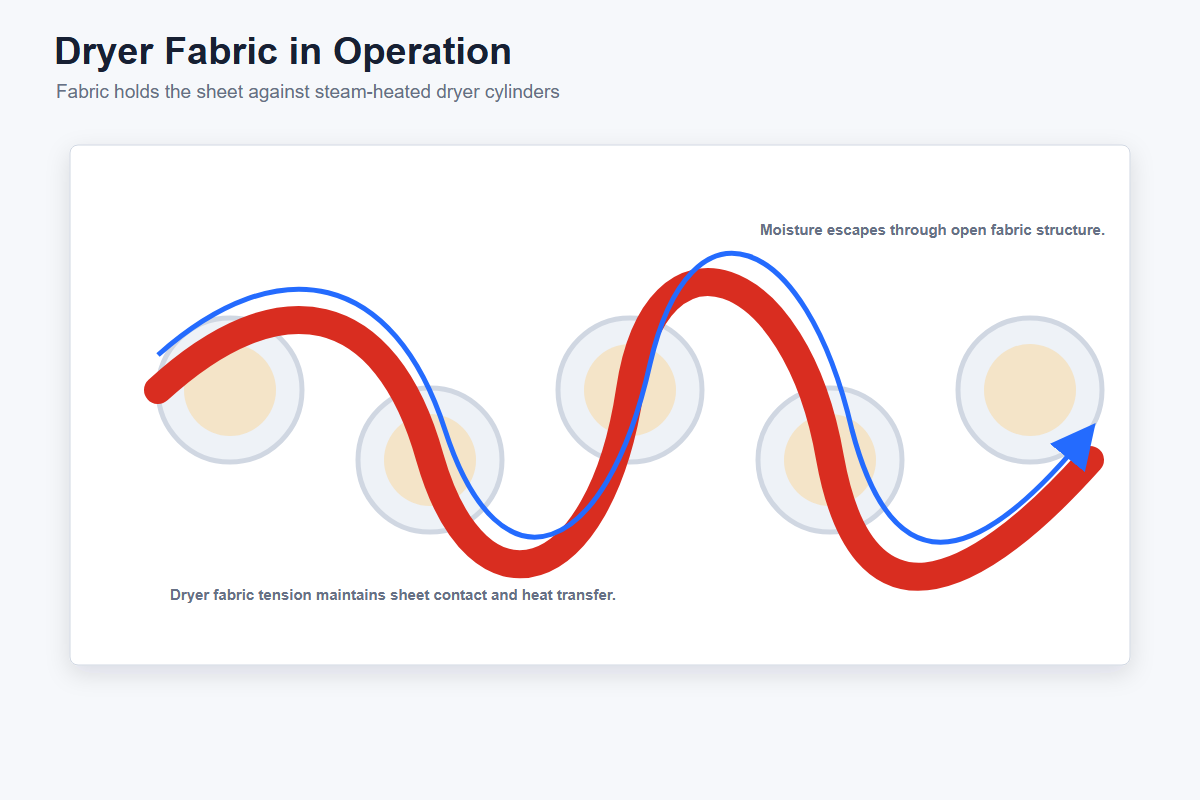 Figure: Polyester dryer fabric installed on a paper machine dryer section. The fabric presses the sheet against steam-heated cylinders (120–180°C) to maximize conductive heat transfer. The dryer section accounts for ~70% of the paper machine's total energy consumption.
Maximizing Dryer Fabric Life
Dryer fabrics represent a long-term investment — with service lives of 6–12 months, the focus shifts from change frequency to optimizing consistent performance throughout the fabric's life.
1. Keep It Clean
Contamination is the #1 cause of premature dryer fabric decline. Stickies (from recycled fiber), pitch (from virgin fiber), and fiber dust accumulate on fabric surfaces, blocking permeability and creating sheet defects.
Cleaning strategies:
- Continuous low-pressure showering with warm water (40–60°C)
- Scheduled high-pressure traversing shower cleaning (100–200 bar, once per shift or daily)
- Chemical cleaning during scheduled shutdowns for heavy contamination
2. Monitor Tension
Excessive tension accelerates fabric wear and increases bearing loads. Insufficient tension causes fabric slippage on cylinders, poor heat transfer, and tracking problems. Monitor tension at installation and periodically throughout fabric life.
3. Inspect Seams Regularly
The seam is the weakest point in any dryer fabric. Inspect the pin or spiral seam during every scheduled shutdown. Look for:
- Pin migration (pin working its way out)
- Loop wear or breakage
- Uneven wear indicating tension imbalance
4. Maintain Roll Surfaces
Worn, corroded, or dirty dryer cylinder surfaces accelerate fabric wear. Keep cylinder surfaces clean and smooth. Inspect felt rolls and guide rolls for bearing condition — a dragging roll creates localized fabric wear.
5. Control the Environment
- Maintain proper dryer section hood ventilation to prevent moisture buildup (reduces hydrolysis risk)
- Control condensate removal from cylinders (flooded cylinders cause temperature variations and poor drying)
- Monitor pocket ventilation air temperature and humidity
Installation Best Practices
Proper installation sets the foundation for the fabric's entire service life:
- Pre-installation inspection: Verify correct fabric dimensions, permeability, and seam type before removing from packaging
- Machine preparation: Clean all cylinder and roll surfaces; verify guide and tension systems are functioning
- Tension during threading: Maintain low, uniform tension to prevent fabric damage during pulling
- Seam joining: Follow seam manufacturer instructions precisely — incorrect seam insertion is a leading cause of premature failure
- Initial tensioning: Bring fabric to operating tension gradually; never shock-load
- Run-in period: Run at reduced speed for the first 30–60 minutes; inspect seam and tracking before ramping to full speed
From Our Factory Floor
A packaging mill in Germany producing testliner at 1,100 m/min was struggling with dryer fabric contamination. Stickies from recycled fiber were accumulating on the fabric surface within 30 days, progressively reducing air permeability. The mill was performing aggressive high-pressure cleaning (200 bar) every two weeks, which was itself accelerating fabric wear — they were averaging only 150 days of service life on fabrics they expected to run 250+ days.
When our engineer visited, he observed that the contamination was concentrated in dryer groups 2 and 3 — the groups where the sheet temperature first exceeds the stickies' softening point. The stickies weren't just on the surface; they had been driven into the fabric structure by the high-pressure cleaning, creating an abrasive internal paste that was wearing yarns from the inside.
Solution: We recommended a two-part change. First, we supplied the next fabric with a contamination-release surface treatment that made stickies less likely to adhere. Second — and more importantly — we worked with the mill to relocate their high-pressure shower from a post-contamination position to a pre-softening position (between dryer groups 1 and 2), where stickies could be removed before they became adhesive. We also reduced cleaning pressure from 200 to 140 bar to minimize fabric abrasion.
Result: The next fabric reached 278 days before scheduled replacement — an 85% improvement. More importantly, it maintained 85%+ of its original permeability throughout its life, meaning consistent drying performance and stable steam consumption. The mill eliminated 5 unplanned fabric changes per year, each of which had cost 6 hours of production.
Lesson: Dryer fabric contamination is a chemistry problem disguised as a mechanical problem. Where you clean is often more important than how hard you clean.
Frequently Asked Questions
What is the typical service life of your polyester dryer fabric?
Service life varies by machine conditions, but our customers typically achieve 180–365 days on standard applications. Key factors include operating temperature, machine speed, paper grade, and cleaning procedures. Dryer fabrics generally last significantly longer than forming fabrics (30–90 days) or press felts (45–90 days) because they handle a mostly-dry sheet and operate with less contamination exposure. We provide specific life expectancy estimates based on your machine parameters.
How do I select the right air permeability for my dryer section?
Air permeability selection depends on your machine speed, paper grade, and dryer section pocket ventilation design. General guidance: 600–800 L/m²·s for low-speed machines (< 500 m/min) and fine paper grades where sheet stability is critical, 800–1,000 L/m²·s for medium-speed machines (500–1,000 m/min), and 1,000–1,200 L/m²·s for high-speed machines (> 1,000 m/min) and packaging grades where maximum drying capacity is needed. Our technical team analyzes your specific operating conditions and recommends the optimal permeability range.
What is the difference between flat woven and double warp dryer fabric?
Flat woven fabric uses single warp yarns interwoven with weft yarns, producing a smooth, uniform surface ideal for fine paper grades where sheet marking must be minimized. Double warp construction uses paired warp yarns for 25–35% higher tensile strength and greater durability — recommended for heavy-duty applications like kraft, linerboard, and packaging paper where mechanical demands are higher. Both constructions are available across the full permeability range.
What seam type should I choose for my dryer fabric?
The three main seam types are: (1) Pin Seam — most common, uses a connecting pin through fabric end loops, quick to install, suitable for most applications; (2) Spiral Seam — uses a spiral wire threaded through both fabric ends, provides superior seam strength and reduced marking on sensitive grades; and (3) Endless — woven as a continuous loop with no seam, best sheet surface quality but requires machine disassembly for installation. Your choice depends on the paper grade sensitivity to seam marking and your installation preferences.
Can you produce custom sizes and specifications?
Yes. All our polyester dryer fabrics are custom-manufactured to your exact specifications including width (up to 12.5m), length, mesh count (20–35 threads/cm), air permeability (600–1,200 L/m²·s), and edge finishing. We also offer special treatments such as anti-static coating, contamination-resistant treatment, and hydrolysis-resistant PET for high-temperature, high-humidity dryer sections.
A Dryer Fabric Maintenance Schedule That Actually Works
The polyester dryer fabric runs 6–12 months. Over that long a life, small differences in daily maintenance compound into large differences in total performance. Here is a practical schedule drawn from mills that consistently achieve 300+ day fabric life.
Daily (Operator Rounds — 5 minutes per shift)
- Walk the fabric loop. Look for: broken yarns (small holes become big holes), edge fraying (the #1 failure initiation point), contamination streaks (indicates a stationary shower nozzle or localized buildup).
- Check the seam. Run your hand along the pin or spiral seam — feel for pin migration (pin working out) or loop elongation. This takes 30 seconds and catches 80% of seam failures before they happen.
- Verify guide paddle function. Observe the guide system responding to small manual disturbances. A sluggish guide that overcorrects is wearing your fabric edges.
Weekly (Maintenance Shift — 30 minutes)
- Measure fabric tension. Use a tension meter (not "feel"). Compare to specification. Tension drift of >10% in either direction warrants investigation.
- Inspect roll surfaces. Run your hand along the surface of each dryer cylinder and felt roll the fabric contacts. A rough spot, groove, or corrosion patch will cut fabric life in half. Mark and schedule any roll that isn't smooth.
- Check shower nozzle patterns. Turn on the cleaning showers briefly. Any nozzle not producing a clean, full fan pattern should be replaced. A single clogged nozzle creates a contamination stripe that grows over weeks.
Monthly (Scheduled Shutdown — 2 hours)
- Deep clean the fabric. Run the fabric at crawl speed. Apply alkaline cleaning chemical through the shower system at 40–60°C. Let dwell for 15 minutes. Rinse thoroughly. This removes the buildup that high-pressure showers alone cannot.
- Measure permeability. Use a portable permeability tester at 3–5 points across the fabric width. Compare readings to the fabric's original specification. Permeability loss of >20% signals progressive contamination or compaction that weekly cleaning is not addressing.
- Document everything. Record: days in service, current tension, permeability readings (with locations), seam condition (photo), any damage noted. Over 2–3 fabric lives, this data reveals patterns that guesswork never will.
Quarterly (Preventive Intervention)
- Rotate or replace guide paddles. The paddles that sense fabric edge position wear down over months. Worn paddles create sloppy guiding that accelerates edge wear.
- Chemical clean with the opposite chemistry. If you normally use alkaline cleaners, do one acid clean to remove mineral scale. If you normally use acid, do one alkaline clean for organic fouling. Alternate chemistry prevents dominant contaminant types from accumulating.
- Review the trend data. Plot permeability over time. Plot tension over time. If either trend is accelerating negatively in the second half of fabric life, your cleaning or tension strategy needs adjustment before the next fabric is installed.
The Payoff
Mills that follow this schedule consistently achieve 280–365 day fabric life. Mills that skip to "run until it breaks" average 150–200 days and suffer 2–3 unplanned changes per year. At $8,000–15,000 per fabric (installed) plus 4–8 hours of lost production per unplanned change, the maintenance discipline pays for itself many times over.
📊 Download the Dryer Section Energy Audit Template
Our engineering team has developed a structured audit template that helps you quantify dryer section energy consumption, identify permeability optimization opportunities across dryer groups, and calculate the ROI of fabric upgrades. Includes steam consumption benchmarks by paper grade and machine speed.
📊 Open the Dryer Energy Audit Template — Interactive energy savings calculator + structured audit template. Quantify steam consumption, identify permeability optimization opportunities across dryer groups, and calculate ROI. Includes steam consumption benchmarks by paper grade.
📧 Want our team to run the analysis? Email us your machine data for a detailed permeability optimization report within 48 hours.
📞 Direct line: +86 135 2311 0033
📦 Product specifications: Polyester Dryer Fabric Details & Specifications
Continue exploring:


